TLDR
No number of reviews flips a switch at Google. Google’s own help page says more reviews and positive ratings “can help” your local ranking and names no threshold. But there are two numbers worth knowing. The first is what customers want to see: BrightLocal’s 2026 survey found 47% of people won’t use a business with fewer than 20 reviews, and 74% look for reviews from the last three months. The second is how many five-star reviews it takes to move your rating, and that one is just math: your review count times the gap to your target, divided by 5 minus the target. With 38 reviews at 4.3, getting to 4.6 takes 29 five-stars. At 4.8, one bad review takes 19 five-stars to undo. The rest of this post shows the work, and the Google Review Calculator does it for your numbers.
The Short Answer: Clear 20, Then Keep Them Fresh
Most “how many reviews” articles give you a number pulled from someone’s gut. Here’s what the actual survey data says.
BrightLocal runs the Local Consumer Review Survey every year. The 2026 edition asked 1,002 US adults how they use reviews. A few lines from it matter more than the rest:
- 47% of consumers won’t use a business with fewer than 20 reviews, and only 9% are willing to use one with five or fewer.
- 74% look for reviews written in the last three months.
- 32% look for reviews written in the last two weeks, up from 20% the year before.
So the answer has two parts. Get past 20, because below that you’re losing almost half the people who look. Then keep new ones coming, because a pile of reviews from 2023 looks like a business that stopped.
Notice what those numbers are not: a Google ranking rule. They’re what people say they want before they’ll call you. That still matters, because a listing nobody trusts doesn’t get the call even when it ranks.
What Google Actually Says About Reviews
Google’s help page on local ranking names three things it weighs: relevance, distance and prominence. Reviews live under prominence, which Google describes as “how well-known a business is.” Then it says this:
This factor’s also based on info like how many websites link to your business and how many reviews you have. More reviews and positive ratings can help your business’s local ranking.
That’s the whole official statement. “Can help.” No count, no formula, no tipping point. Anyone selling you a number that guarantees a map pack spot is guessing.
If you want the full picture of what moves map rankings, the map pack guide covers the rest.
The Formula for Raising Your Rating
Your star rating, on the other hand, isn’t a mystery at all. Google’s help page says the score “is the average of all ratings published on Google for that place or business.” An average can be calculated. So here’s the formula for how many five-star reviews it takes to reach a target:
Five-star reviews needed = reviews × (target - rating) ÷ (5 - target), rounded up.
A few examples:
| You have | Rating now | Target | Five-stars needed |
|---|---|---|---|
| 20 reviews | 4.5 | 4.7 | 14 |
| 38 reviews | 4.3 | 4.6 | 29 |
| 50 reviews | 4.6 | 4.8 | 50 |
| 100 reviews | 4.8 | 4.9 | 100 |
Look at the last two rows. The higher you go, the more each tenth of a star costs, because every new five-star has less room to pull the average up. Going from 4.8 to 4.9 with 100 reviews takes another 100 perfect ones.
What about 5.0? Once a business has a single review below five stars, its average can get very close to 5.0 but can never reach it exactly. The bottom of the formula, 5 minus the target, hits zero. Chasing a perfect score is chasing something the math won’t give you. For most businesses, 4.7 to 4.9 is the sweet spot.
That’s also roughly where customers draw their lines. In the same 2026 survey, 68% of consumers said they’ll only use a business with four or more stars, up from 55% in 2025, and 31% want 4.5 or more, up from 17%. Only 10% insist on a perfect five.
What One Bad Review Really Costs
Everybody worries about the one-star review. Here’s how to put a number on it.
The five-star reviews it takes to climb back to where you were is:
(rating - 1) ÷ (5 - rating)- At 4.0, one 1-star review takes 3 five-stars to undo.
- At 4.5, it takes 7.
- At 4.8, it takes 19.
- At 4.9, it takes 39.
Here’s the surprising part: your review count doesn’t change that number. At 4.8, one bad review costs 19 five-stars whether you have 20 reviews or 500.
What your count does change is how far the rating falls in the meantime. One 1-star review drops a business with 20 reviews at 4.8 to about 4.62. The same review drops a business with 50 reviews at 4.8 to about 4.73. A bigger cushion means a smaller dent, which is one more reason to keep reviews coming before you need them.
The Rating Google Shows Isn’t Exact
Two more things trip people up.
The rounding. Google displays one decimal place. Its help page doesn’t say how it rounds, so a business that shows 4.8 could be sitting anywhere near that number. That’s why the calculator aims at the exact average, not the displayed one. If you aim at “4.8” and land at 4.75, you might not see 4.8.
The delay. Google’s help page says that after someone leaves a new review, “it may take up to 2 weeks to get an updated review score.” So don’t panic, or celebrate, the same afternoon.
How Long It Takes at Your Pace
The formula tells you how many. Your pace tells you how long.
Count your Google reviews from the last three months and divide by three. That’s your monthly pace. If you need 29 five-stars and you get about 3 a month, that’s around 10 months, and only if every one of them is five stars. Real life is slower.
That’s the moment most owners realize the problem isn’t their reputation. It’s that nobody asks. BrightLocal’s 2026 survey found 83% of people who were asked to leave a review went on to leave one that year. Read that carefully: it counts people over a whole year, not the odds that any single ask works. But it says the ask matters more than almost anything else.
How to Get Them Without Breaking Google’s Rules
The rules are short, and they’re strict.
No incentives. Google’s help page on asking for reviews says:
Offering incentives, like free or discounted goods or services, in exchange for customers to post reviews, change reviews, or remove negative reviews is considered fake & misleading content and is strictly prohibited.
No discount for a review. No raffle entry. No free add-on.
No cherry-picking. Google’s contributions policy says merchants may not “selectively solicit positive reviews from customers.” That rules out the trick where you send everyone a “how did we do?” form and only forward the happy ones to Google. Ask everyone, the same way.
Make it one tap. Google’s help page says customers can leave a review by visiting a Google link or scanning a QR code, and your Business Profile can make both. A link that opens the review box directly beats “find us on Google Maps” every time.
Then make asking a fixed step at the end of every job instead of something you remember on good days. The guide to getting more Google reviews walks through the whole routine, including how to answer the bad ones.
Run Your Own Numbers
The Google Review Calculator does all of the above for your listing. Put in your rating, your review count and the rating you want. It shows the five-star reviews it takes, how long at your current pace, how long if you asked every customer, and what one bad review would cost you. There’s an optional spot for a competitor’s rating and review count, too.
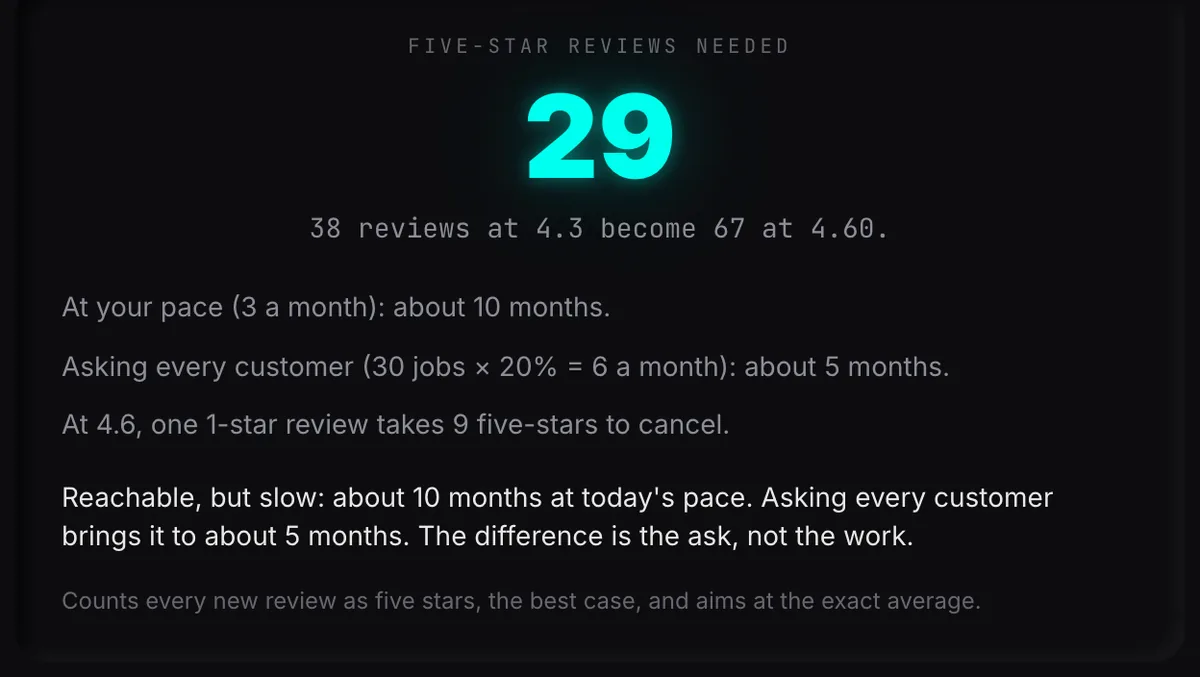
It’s free, every outside number on the page names its source, and the one estimate on it is labeled as mine.
I appreciate you reading this one. If you’d rather have someone handle the asking for you, review requests are part of Steady Search: a one-tap review link and the text and email templates your team sends after every job. Or book a call from the home page and we’ll look at your listing together.
Quick answers
How many Google reviews does a business need? +
At least 20, and recent ones. BrightLocal's 2026 Local Consumer Review Survey found 47% of consumers won't use a business with fewer than 20 reviews, and 74% look for reviews written in the last three months. Google itself gives no minimum.
Is there a number of reviews that makes Google rank you higher? +
No. Google's help page on local ranking says "More reviews and positive ratings can help your business's local ranking," but it names no threshold. Reviews feed what Google calls prominence, alongside relevance and distance.
How do I calculate how many 5-star reviews I need? +
Multiply your review count by the gap to your target, then divide by 5 minus the target, and round up. With 38 reviews at 4.3, reaching 4.6 takes 38 × 0.3 ÷ 0.4 = 28.5, so 29 five-star reviews.
How many 5-star reviews cancel out a 1-star review? +
It depends on your rating, not your review count. The formula is (rating - 1) ÷ (5 - rating): 7 at 4.5, 19 at 4.8 and 39 at 4.9. More reviews make the drop smaller, but the number it takes to climb back stays the same.
Can a business have a perfect 5.0 rating? +
Only until its first review below five stars. After that, the average can get very close to 5.0 but never reach it exactly, no matter how many five-star reviews follow. Aiming for 4.8 or 4.9 is a better use of the effort.
How does Google calculate the star rating? +
Google's help page says the score "is the average of all ratings published on Google for that place or business." It shows one decimal place, doesn't say how it rounds, and notes that a new score can take up to 2 weeks to update after a review.
What star rating do customers expect? +
Four stars or better for most people. BrightLocal's 2026 survey found 68% of consumers will only use a business with four or more stars and 31% want 4.5 or more, both up sharply from the year before. Only 10% insist on a perfect five.
Can I offer a discount in exchange for a Google review? +
No. Google's help page says incentives "like free or discounted goods or services" in exchange for reviews are "considered fake & misleading content and is strictly prohibited."
Can I only ask happy customers for reviews? +
No. Google's contributions policy says merchants may not "selectively solicit positive reviews from customers." Ask every customer the same way, at the same point in the job.
What's the easiest way to ask for a Google review? +
Send a direct link that opens the review box. Google's help page says you can ask customers to visit a Google link or scan a QR code, and your Business Profile can generate both. Ask in person when the job is done, then send the link the same day.
Keep reading
- I Gave Away 18 Free Tools (And Wrote Rules So They Can't Lie to You)Seven AI research agents argued about my website for a day. What came out was a set of free tools with one strict rule: every number has a source, every assumption is visible, and the tool is allowed to tell you not to hire me. Here's how they got built, what we refused to build, and what I still don't know.
- How Much Does a Website Cost in 2026? Here Are My Actual PricesMost "how much does a website cost" articles give you a range so wide it's useless, then ask you to book a call to find out. Here's the opposite: every price I charge, what's inside each one, what it costs to keep the site running, and when I'd tell you to buy something cheaper than what I sell.
- I Taught My AI to Forget (Why Memory Needs a Garbage Collector)Everyone's racing to give their AI more memory. Mine has about 700 memories, and the most useful thing I built this year was a way for it to forget. Every memory now has a birth date, an expiration date, a source, and a confidence level, and on the day I checked, only about one in nine made it into the room. Here's why forgetting is the next frontier for AI that works with you for years.