Skip to content

Pick a time for your free call

Loading calendar…

Calendar not loading? Open it on Cal.com

Why boring

The smartest automation is the boring one.

The flashy AI demo is fun to watch. The boring workflow is the one that pays. A lot of businesses buy more leads while yesterday's leads still wait for a reply. Quotes go unchased. Invoices get retyped by hand. A customer list nobody has emailed since 2024 sits in the CRM. None of that is exciting, but all of it is money. Fix those first, then buy more leads.

Boring automations win for 3 reasons. They follow rules you can write down, so they run the same way every time and are easy to test. They usually need no new app and no new login for your team. And the math fits on a napkin, in your own numbers, before you pay a dollar. The leverage is in the dull job you do 50 times a week, not the clever one you do twice a year.

One rule before anything gets wired: do the job by hand first. If you can't write the steps down, nobody can automate them. I do that part with you on the call.

What gets wired

Ten boring jobs. Three kinds of payoff.

Each one is a fixed-scope build, written in your voice, documented with a walkthrough video, and maintained by me.

Makes money

Revenue that was already yours.

Speed to lead

A form fill or a missed call gets a personal reply by text or email in under 60 seconds. The lead gets qualified, the right person gets pinged with the context, and a link to book the next step lands before your competitor opens their inbox.

For: Any business that pays for leads.

The math

40 leads a month, a 25% close rate and a $1,000 job. If replies within the hour reach 70% of them, about $3,000 a month goes quiet. Example numbers, change them →

Follow-up that doesn't quit

Quotes chase themselves on day 3 and day 10. No-shows get a link to rebook. Every message is written in your voice, and the sequence stops as soon as a human replies.

For: Anyone sending quotes and losing them to silence.

The playbook

The exact texts for day 3 and day 10, the no-show message, and the 1 rule that keeps it human. Read the follow-up guide →

Database reactivation

Past customers, old quotes, trial users and leads that went quiet get a personal message about their own history with you. No blast, and an opt-out in every message. If 2 in 100 reply, those are conversations you didn't buy an ad for.

For: Anyone with a few hundred contacts nobody is working.

The math

2 in 100 is an assumption, not a result. Bring your contact count, your average job and what you can spend to win one back, and the math takes 1 minute. Book the call →

A review engine on autopilot

A timed ask after every job, sent to every customer the same way, with a direct link to your Google profile. Reviews stack up while you do the actual work.

For: Local businesses that win work on Google Maps.

The math

47% of people won't use a business with fewer than 20 reviews (BrightLocal, 2026). Google Review Calculator →

Saves money

Costs that stop showing up.

Paperwork that files itself

Invoices, intake forms and PDFs get read, checked against your categories, flagged when something is off, and pushed into your books or your CRM, with one human glance at the end. Rule-based wherever it can be, so it's cheap to run.

For: Anyone paying a person to retype documents.

The math

5 hours a week of retyping at $30 an hour is 780 hours and $23,400 in labor over 3 years. Example numbers, change them →

Invoices that chase themselves

An overdue invoice gets a polite reminder on day 1, day 7 and day 14, or whatever schedule you set, in your voice, with the pay link right in it. It stops as soon as the payment is recorded, and you never write the awkward email again.

For: Anyone who does the work first and gets paid after.

The math

Add up what's past due today. That's the number this one goes after. Book the call →

Dispatch without the retyping

Phone orders, job changes and schedule moves land in the exact format your crew already reads, every morning, without anyone typing them in. That means fewer double-booked trucks and fewer wrong addresses.

For: Trades, crews and delivery: anyone scheduling people and vehicles.

The math

30 minutes of typing every weekday morning is 130 hours a year. Put yours next to what it costs to wire once. Hire vs. Automate →

Saves time

Hours back, every week.

The numbers in your pocket

Every morning, 1 text or Slack message with 3 numbers: yesterday's leads, jobs booked and money in, pulled from the tools you already use. You get an alert when a job slips or a deal stalls, and there's no dashboard to log into.

For: Any owner who asks “how did we do yesterday?” and waits for the answer.

The math

Score the report somebody builds by hand. 75 to 100 means it fits automation almost end to end. Workflow Automation Score →

Intake that fills itself

Leads land tagged, deduped and routed. The calendar, the CRM and the inbox agree with each other. Nobody copies a phone number from one tab to another again.

For: Anyone running the business out of 4 inboxes.

The math

In the tool's lead-intake example, 10 hours a week scores 85 of 100, and the tool estimates 442 of those 520 hours a year could come back. Example numbers, change them →

Voice note to document

Record the walk-through on your phone. A formatted estimate, proposal or job sheet comes back in your words, with your prices, ready for one read before it goes out.

For: Estimators, inspectors and anyone who writes the same document after every visit.

The math

30 minutes of writing after each of 10 visits a week is 5 hours a week, 780 hours over 3 years. Example numbers, change them →

Receipts over promises

This page answers its own form. In a test, my auto-reply left about 1 second after the form was sent. One reply per address a day. Try it.

Measured October 31, 2026

I run Pharallax, an analysis engine that researches, writes, quality-scores and delivers reports end to end without a human in the loop.

Email flows live in production for a specialty food brand. The full case study publishes after client sign-off.

How it starts

Start with the one closest to money.

  1. A 30-minute call

    One question does most of the sorting: if 500 new customers showed up tomorrow, what breaks first?

  2. Do it by hand once

    We run the job together, by hand, and write every step down. If a step can't be written, it doesn't get wired.

  3. I wire it

    In your voice, on the tools you already use. You get a walkthrough video of how it works and where it lives.

  4. It runs

    I maintain it. If your site is on the Business care plan ($295 a month), keeping your automation running is part of it.

Prices updated October 28, 2026

Automation, straight answers.

Who sets up automation for a small service business, like missed-call text back and fast lead follow-up? +

I do. I'm Russ Gardner, and generuss design wires the boring automations that make or save the most money: an instant reply to every new lead and missed call, follow-up on quotes and no-shows, a review ask after every job and one clean CRM behind them, plus back-office jobs like paperwork entry, overdue invoice reminders and a morning numbers report. Each one is a fixed-scope build, written in your voice and maintained by me.

What is a boring automation? +

A job your business already does by hand, the same way, over and over, wired to run without a person: the first reply to a lead, the quote follow-up, the invoice entry, the morning numbers. Usually no new app for your team, and no AI theater. If it's dull and repeatable, it's a candidate.

Why start with a boring automation instead of an AI agent? +

Because the boring one is the easiest to price, test and pay back. It follows rules you can write down, so it's easy to test, your team rarely has to learn anything new, and I work out the payback in your own numbers before I quote the build. The clever build can come after the dull one has paid for it.

Which automation should I do first? +

The one closest to money. Leads waiting more than 5 minutes for a reply: speed to lead. A few hundred old contacts nobody emails: reactivation. Someone retyping paperwork an hour a day: document processing. On the call I ask one question that sorts it: if 500 new customers showed up tomorrow, what breaks first?

Do I need a new CRM or new software? +

Usually not. I check what your current software already does before I quote anything, then build on what you use and put the output where you already look: your inbox, your phone, your calendar, your books. A new tool is the last resort.

Is it legal to text my leads and old customers? +

Yes, when it's set up right. Before anything sends, I check who you have permission to contact, record consent where it's required, and put an opt-out in every text sequence. Marketing emails carry your business address and an unsubscribe link. An old contact record alone isn't permission to text, so old lists usually start with email.

What do you actually automate for a service business? +

10 boring jobs in 3 groups. 4 make money: speed to lead, quote and no-show follow-up, database reactivation and review requests. 3 save money: paperwork entry, overdue invoice reminders and dispatch. 3 save time: a morning numbers report, lead intake and voice note to document. Each one runs after a single setup.

Does automation make my business feel robotic to customers? +

Done badly, yes. Every sequence I wire is written in your voice, timed like a human would time it, and stops as soon as someone replies. Customers experience it as you being impressively on top of things.

What does an automation build cost? +

A single automation, like speed to lead or a review engine, is a fixed-scope build quoted after a short call. If your site is on the Business care plan ($295 a month), keeping your automation running is part of it. Run the calculators first: they tell you what doing nothing costs, which is the number that matters. Prices updated October 28, 2026.

I'm not technical. Who maintains this? +

I do. Everything ships documented with a walkthrough video, so you can see what runs and where. If something breaks, it's my phone that buzzes, not yours.

Are your automation calculators honest, or just built to scare me into booking a call? +

They are built to give you an honest number, and they are allowed to tell you that you are fine. Every outside number in my tools has a real, dated source, and every assumption sits where you can see it and change it. The Missed-Lead Calculator runs on your own lead volume, close rate and response time, not an industry average you don't recognize. Hire vs. Automate shows both columns, so if hiring is the better call, you will see that too. I wrote up the rules behind the tools and how they got built in the post linked here.


Find your most boring win in 30 minutes.

Free discovery call. We find the one job closest to money, and you leave with the fix list whether we work together or not.

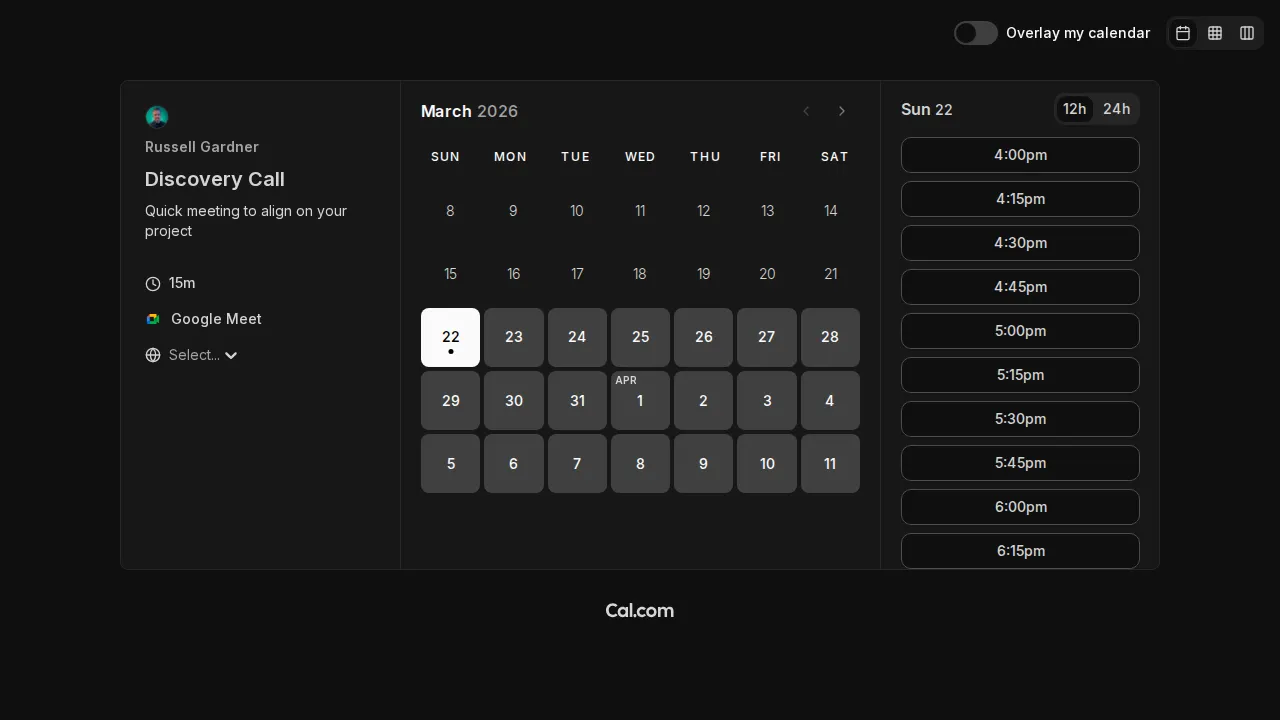
Calendar preview showing available booking times
Russ Gardner 30 min · Pacific Time
Discovery Call Google Meet

If the calendar doesn't load, schedule directly here.

Not ready for a call?

Tell me the job you're sick of doing

Two sentences about the job you or your team do by hand every week. I reply with the one automation I'd build first, no drip campaign attached.